Most people find us in the middle of a change. A new role that does not feel like yours yet. A breakup, a move, a burnout you are still climbing out of. The outside has moved on, and the inside has not caught up.
We wrote The Midnight Alchemist Guide for that gap. It is free, 27 pages, and made to read on a phone. You do not need the app to use it.
What is inside
The guide has four parts and a short close.
- Part I, the idea. What alchemy means and why it helps with identity work. What identity change is, how to move from where you are (A) to who you are becoming (B), and the four stages, nigredo, albedo, citrinitas and rubedo, in order and in everyday life. It also explains identity lag: when your life has changed but your sense of yourself has not. If you have been asking whether it is imposter syndrome or something else, start there.
- Part II, where it comes from. Historian Lawrence Principe places alchemy’s origins in Hellenistic Alexandria (Principe, 2013). Our review of the literature finds its religious and philosophical foundation was born earlier, in Kemet, the people’s own name for the land later called Egypt. The guide then follows the ideas through Baghdad and Timbuktu to Carl Jung.
- Part III, the practice. A prompt for each stage, four tools for getting from A to B, a morning, midday and evening routine, a short guide to saying it out loud, and a seven-day plan.
- Part IV, the app. Where the Midnight Alchemist App stands today, five lessons from testing it, and what happens to your data.
- The close. What our mark, The Alembic, means, and every source we used.
Is inner work about becoming better?
Partly. It moves you from A towards B, but not as self-improvement in the usual sense. For Jung, the aim was wholeness, not perfection (Jung, 1959). And B is a draft. When people step into bigger roles, they try out “provisional selves”, keeping some and dropping others (Ibarra, 1999).
The guide shows how this plays out with people, in your own head, at work and with money. It uses everyday examples, not promises.
Three things to try tonight
- Say out loud: “I am becoming someone who …” Keep it small. Psychologists call these imagined futures possible selves (Markus and Nurius, 1986).
- Write one if-then plan for tomorrow: “If the meeting opens, then I will speak within five minutes.” Across 94 tests, plans in this form helped people reach their goals (Gollwitzer and Sheeran, 2006).
- Before sleep, review the day without a verdict. What happened? What did I feel? What helped?
Then repeat. In one study, a new daily habit took a median of 66 days to feel automatic for the people whose data could be modelled, and missing a single day did not undo it (Lally et al., 2010).
Get the guide
Free, 27 pages. Read it on your phone tonight, or share this page with someone in a season of change.
Free download · 27 pages · PDF
Get The Midnight Alchemist Guide
Enter your email and we send you a link from support@themidnightalchemist.com. Open it and tap Confirm: your download then starts and the PDF arrives in your inbox. You also join the waitlist: one email when a place opens. No spam. Read our privacy policy.
For short lessons on Carl Jung, inner work and shadow work, follow us on Instagram and TikTok at @midnightalchemistapp.
Frequently Asked Questions
Is the guide free?
Yes. Enter your email, then open the link we send and tap Confirm. Your download then starts and the PDF arrives in your inbox. You also join the waitlist: one email when a place opens.
Do I need the app to use the guide?
No. Every exercise in the guide works with a voice note or a notebook. The app is an Android build in private testing, with a waitlist open.
Is this therapy?
No. The guide and the app are a reflection practice, not therapy, diagnosis or treatment, and they make no promises about outcomes.
The gold was always there
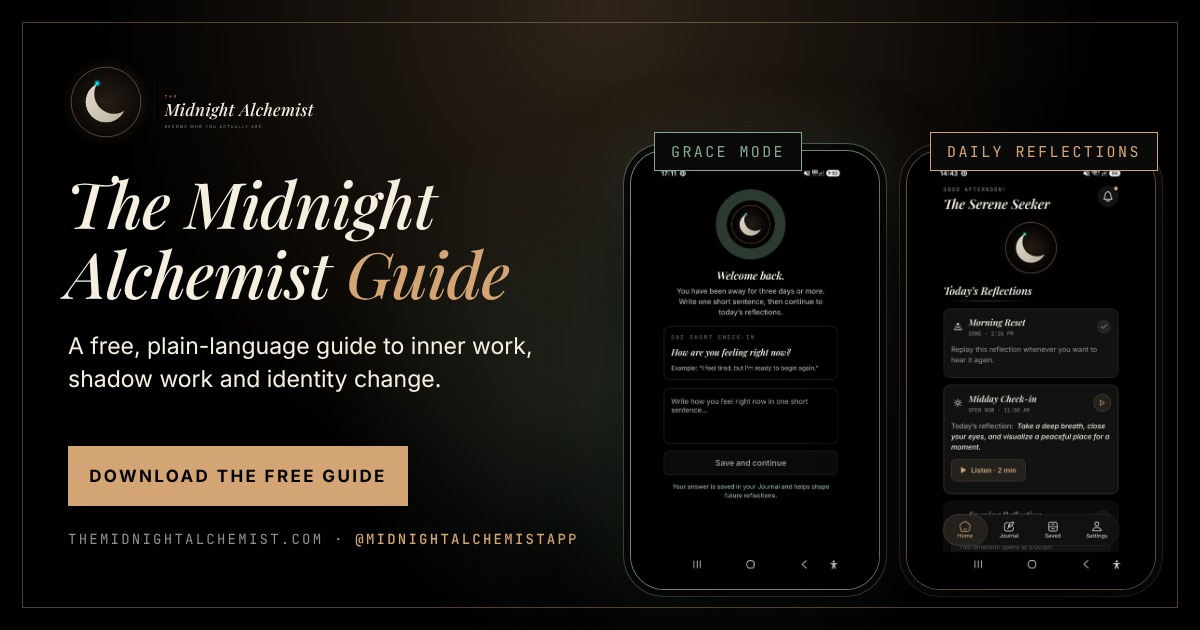
The practice this writing comes from: short daily reflections to read or hear with your phone’s speech voice, plus a private journal.
- I · MORNING
- II · MIDDAY
- III · EVENING
Prime
A short Ritual written for the person you are becoming.
Act
One aligned action, logged while it is still true.
Release
The Shadow Log — say what the day asked of you.
Android private testing is currently free for invited testers. The public release will have a paid monthly subscription. Join the waitlist for availability.
Short films from this research — follow on TikTok.
References
- Gollwitzer, P.M. and Sheeran, P. (2006) ‘Implementation intentions and goal achievement: a meta-analysis of effects and processes’, Advances in Experimental Social Psychology, 38, pp. 69–119. doi:10.1016/S0065-2601(06)38002-1
- Ibarra, H. (1999) ‘Provisional selves: experimenting with image and identity in professional adaptation’, Administrative Science Quarterly, 44(4), pp. 764–791. doi:10.2307/2667055
- Jung, C.G. (1959) Aion: Researches into the Phenomenology of the Self. Collected Works, vol. 9ii. Princeton: Princeton University Press.
- Lally, P., van Jaarsveld, C.H.M., Potts, H.W.W. and Wardle, J. (2010) ‘How are habits formed: modelling habit formation in the real world’, European Journal of Social Psychology, 40(6), pp. 998–1009. doi:10.1002/ejsp.674
- Markus, H. and Nurius, P. (1986) ‘Possible selves’, American Psychologist, 41(9), pp. 954–969. doi:10.1037/0003-066X.41.9.954
- Principe, L.M. (2013) The Secrets of Alchemy. Chicago: University of Chicago Press. A general-audience book by a historian of science.